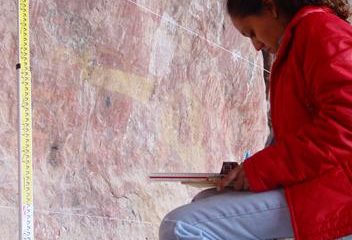
Defining the pre-Olmec people of Guerrero is a difficult task since relatively little is known about them. While the Olmec mural of Cauadziziqui provides the Formative period ceiling, the pre-Olmec mural may date any time before that, although a Paleo-Indian date for the mural seems unlikely. Notably, there are no mammals in the pre-Olmec mural, and there are rockshelters near Cauadziziqui depicting elaborate hunting scenes of herds of deer stalked by humans in a distinctive style. The pre-Olmec mural painters may have actually been the same people who painted the Olmec mural (1200-600 BC). Other possibilities: the pre-Olmec mural painters were coeval with the Olmec painters; or the pre-Olmec mural may have painted during the initial Early Formative (1700-1200 BC) or Archaic periods (3500-8000). Given the content of the pre-Olmec mural, including sprouting plants, humans and the sun, plant cultivation seems to have been a key interest. Dating of the pigments will narrow the time frames for the creation of both murals.
Supporting the notion of pre-Olmec peoples’ interest in plants are recent dramatic finds in caves from the Iguala and Tlaxmalac drainages of the Balsas River Basin, Eastern Guerrero, which have recorded domesticated maize and cucurbita in phytolith form and starch grains dating between 6770 and 6680 BC from this seasonal tropical forest area. Further, Piperno and others have argued that foragers played a more active and conscious role as agents in the selections of food resources by evaluating their energetic returns and labor investments in a model based on optimal foraging strategy. The ideas of Piperno and associates are appealing because they shift attention from plant domestication to plant cultivation, with the causation of the domestication process resting on the agency of foragers.
The Neolithic transition in Mesoamerica brought profound changes in: subsistence strategies with the transformation of hunting and gathering economies to full agriculture; the domestication of cultivars (especially maize); the establishment of sedentism; the emergence of ranked societies, monumental architecture and sculpture, hierarchical settlement patterns, and complex iconographic programs. These developments have been reported in many areas of Mesoamerica, from highlands to lowlands. Nevertheless, there exist disagreements and competing narratives about how and why these changes happened and the timing in each region. Guerrero poses an intriguing problem, if maize was domesticated so early in the Balsas River Basin, why have no precocious Neolithic cultural developments been found like those in the Soconusco or Oaxaca? The paucity of archaeological research is partially to blame, but another possibility is that mobile forager-cultivators continued operating in the Balsas depression well into the Early Formative period, as is argued for the Tuxtla Mountain region of the Gulf Coast. Such may have been the case for Cauadzidziqui.